Almost every host who asks me this has the wrong rule in their head. Usually it’s the 90-day one, applied to a property it was never meant to cover.
Here’s the actual position, in the order that matters.
Why you need permission at all
You’ll see Rent Pressure Zones mentioned constantly in this context, usually without anyone explaining the connection. Here it is.
A Rent Pressure Zone is a rent control measure. Inside one, a landlord can raise the rent on a long-term tenancy once a year, by inflation or 2%, whichever is lower. On the face of it, nothing to do with short-term letting.
The link is mechanical. The 2019 short-term letting regulations used RPZ designation as their geographic trigger. Inside an RPZ, short-term letting loses its “exempted development” status. Losing that exemption is what creates the planning permission requirement. Outside an RPZ, the restrictions didn’t apply at all.
So RPZ status doesn’t affect your nightly rate, your occupancy or your tax. It decides one thing: whether you need planning permission.
Rent Pressure Zones went nationwide on 20 June 2025. Everywhere in Ireland is now inside one.
That’s the part a lot of hosts have missed. Two years ago, this was mainly a Dublin and cities problem. Now it reaches every town in the country. If you’re working from guidance written before mid-2025, check it again. The same goes for anything another host told you back then.
One wrinkle worth knowing: the 2019 regulations define a short-term let as 14 days or less, while the new Fáilte Ireland register uses 21 nights or less. Two different thresholds run side by side until the new regime commences.
Which of the three situations are you in?
The rule depends on what you’re letting. Town size is a second question. It only affects one of the three answers.
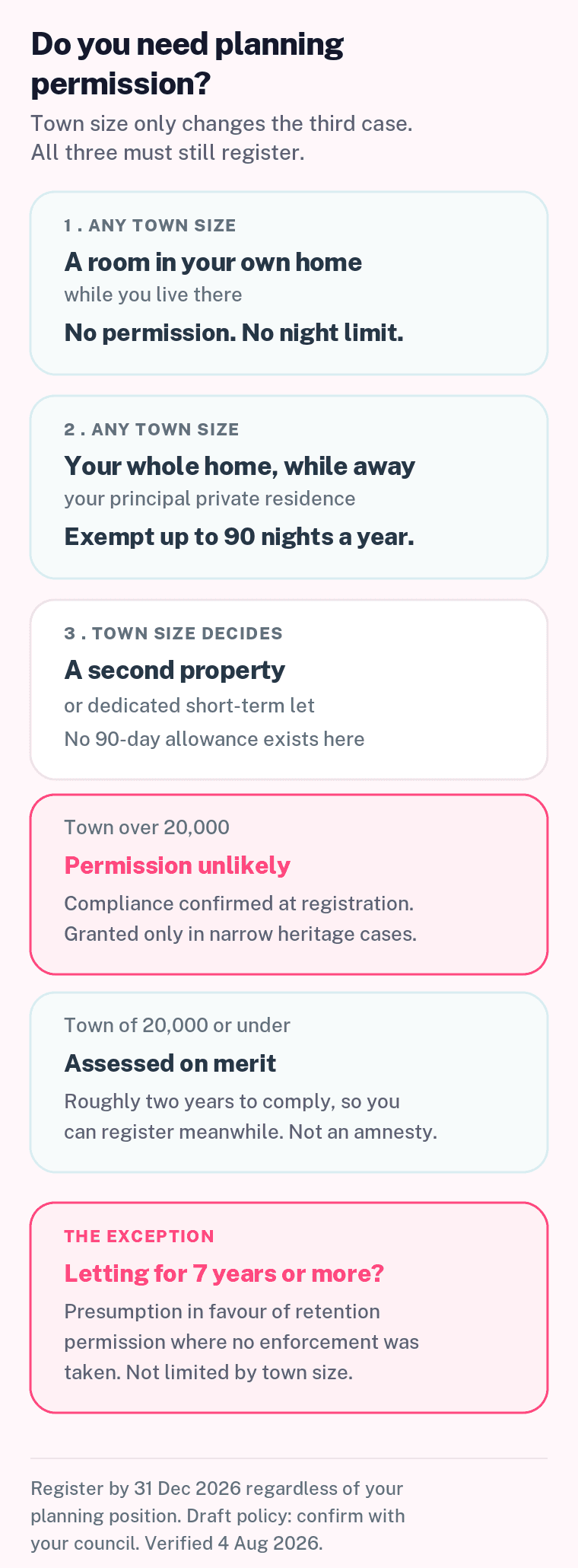
A room in your own home, while you live there
Exempt from planning requirements entirely, on an unrestricted basis. No night limit. The 90-day figure you may have read about does not apply to you.
Your entire principal private residence, while you’re temporarily away
Exempt up to 90 cumulative days a year. Past 90 days you need change of use permission.
This is the only situation the 90-day allowance applies to, and it gets misquoted constantly.
A second property or a dedicated short-term let
No 90-day allowance exists here. You need planning permission from the first night. This is where town size starts to matter.
Town or city over 20,000 people (2022 Census). You must confirm planning compliance at the point of registration, with no lead-in period. Councils will generally not grant new permission for short-term letting. The narrow exceptions: preserving a heritage building, bringing vacant space above a shop back into use, or using a small existing structure in the grounds of a property.
Town of 20,000 or under, and rural areas. You get roughly two years to reach compliance. Councils will assess applications on their merits. They’ll weigh local housing need, how many lets are already concentrated in one estate or block, and traffic, flooding or pollution risk. Treat this as a lead-in period, not an amnesty. The 2019 regulations remain live, and councils can still enforce. The guidance doesn’t yet confirm whether the two years runs from registration or from commencement.
Whichever situation you’re in, you still have to register with Fáilte Ireland by 31 December 2026. A planning exemption is not a registration exemption. The register deadlines are set out here.
Establishing your status is not the same as applying
This distinction matters more than anything else on this page. Almost nobody draws it.
Establishing your status is private and reversible. You can check your council’s online planning register for your property’s history. You can check whether an enforcement file exists against it. You can check whether an existing permission already covers tourism use, count your years of continuous letting, and take private professional advice. None of that creates a record or tells anyone anything.
Applying is public and permanent. It goes on the planning register, where it stays. And a retention application is, in substance, a written notice to your council that unauthorised development is happening on your site.
That asymmetry matters, because a refusal is genuinely damaging. Planning history is a material consideration. A later application for substantially the same thing tends to be refused on consistency grounds, unless something material has changed. And a refused retention application leaves the council holding documented evidence of an unauthorised use, in writing, from you.
So establish your status now, whoever you are. Whether to apply, and when, depends entirely on which category you’re in.
If your town is 20,000 or under, there is a strong argument for not applying yet. Anyone applying today is applying under the old framework. The National Planning Statement is still in draft. The Bill isn’t enacted. The simplified retention route for short-term lets hasn’t been published, and the seven-year presumption isn’t law. Every one of those changes is in your favour. Applying now forfeits all of them, risks a refusal, and leaves you facing the better regime with an adverse history. You have roughly two years. Use some of it.
If your town is over 20,000, the urgency is real, but “just apply” is still wrong advice. New permission there is generally refused, except in narrow heritage or vacant-space cases. If you have neither a seven-year case nor an exception, applying now means a near-certain refusal. That leaves you in the same difficult position, only with a refusal on file. Establish your status urgently, because you must declare compliance at registration with no lead-in. Then apply only if you have a case worth making.
Two things to be straight about. First, waiting is not risk-free: the 2019 rules are live now, Rent Pressure Zones are nationwide, and councils can enforce in the meantime. Second, the wording of the registration declaration has not been published. If it reads “I confirm this unit complies,” an owner who isn’t compliant can’t sign it honestly, even with two years still to run. The Department’s guidance implies smaller-town hosts can register while working towards compliance. But that has to show up in the declaration wording, and we haven’t seen it yet.
A worked example: two houses, 12km apart
Take a three-bed second property let year-round on Airbnb, in Tramore, Co. Waterford. Tramore had a population of 11,277 at the 2022 Census, so it sits under the 20,000 threshold.
Where that owner stands today. Waterford City and County Council’s area is a Rent Pressure Zone, so the 2019 rules already apply. The house isn’t a principal private residence, so there’s no 90-day allowance and no exemption form to file. This owner needs change of use planning permission, and most owners in this position don’t have it.
What changes. This owner must register with Fáilte Ireland by 31 December 2026, regardless of planning status. Because Tramore is under 20,000, the owner gets roughly two years to reach compliance and can register in the meantime. The council will judge an application on local housing need, how many lets are already concentrated in the estate, and traffic, flooding or pollution risk. In a town of 11,277 with genuine tourism demand, that’s a real conversation rather than a refusal.
What that owner should actually do. Establish the planning status now, privately. Then wait. Applying this autumn means being judged under the current framework. The simplified retention route and the seven-year presumption are both coming, and both would help. Applying now misses them. A refusal now would count against the better application available later.
Now move the same house 12km up the road into Waterford City, which is comfortably over 20,000. You must confirm compliance at registration, with no lead-in period. Councils generally refuse new permission there too, except in narrow heritage or vacant-space cases. Same owner, same house, same council, materially different outcome.
If you’ve been letting for seven years or more
There’s a significant exception. Where a dwelling has been used continuously for short-term letting for seven years or more and no enforcement action was taken, there’s a presumption in favour of granting planning permission. Nothing in the published guidance limits this by town size. That would make it the main route available to long-standing operators in Dublin, Cork and Galway.
It isn’t automatic and there are conditions. I’ve covered how it works, what evidence you’d need and what it costs in a separate guide: the seven-year retention permission route for Irish short-term lets.
What to do next
Work out which of the three situations you’re in. Most people get this wrong first time.
If you need permission, establish your status privately. Don’t file anything yet.
Check whether you have a seven-year case.
Register with Fáilte Ireland between 1 and 31 December 2026, whatever your planning position.
Planning status now directly affects what your property is worth as a letting business. That’s as much a numbers question as a legal one. If you’d like a second pair of eyes on where your listing stands, and what the new rules are likely to do to your occupancy and rates in 2027, send me the listing URL. I’ll come back to you with a free review.
Based on guidance published by the Department of Enterprise, Tourism and Employment, Fáilte Ireland and Citizens Information, and on the draft National Planning Statement on Short-Term Letting. This is general information, not legal or planning advice. Planning enforcement is a matter for your local authority, and you should take professional planning advice before making an application.
Sources
Short-term letting in Ireland, what you need to know, Dept. of Enterprise, Tourism and Employment
Renting your property for short-term lets, Citizens Information
Regulation of Short Term Letting, Waterford City and County Council
New legislation extends Rent Pressure Zones nationwide, Residential Tenancies Board
Related posts
Letting for Seven Years or More? The Retention Permission Route for Irish Short-Term Lets
Seven years of continuous letting with no enforcement action opens a route that's otherwise closed, and it doesn't appear to be limited by town size.
Find out what your listing could earn.
Request a free review and get a clear, practical read on your Airbnb or short-term rental performance.